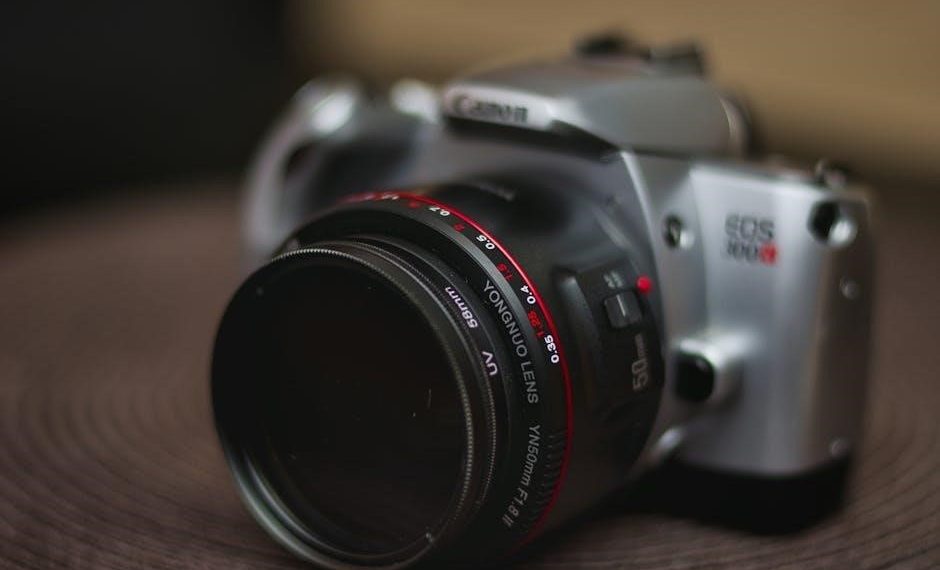
canon rebel xs user manual
The Canon Rebel XS (EOS 1000D) offers a user-friendly experience, detailed in its manual, for beginners exploring DSLR photography with accessible features and guidance.
What’s in the Box
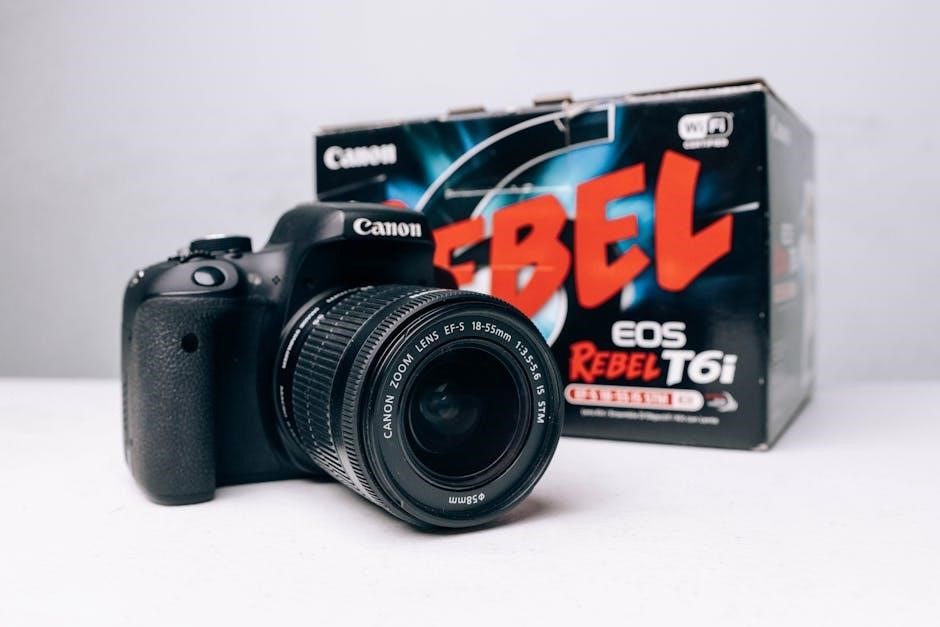
Upon unboxing your Canon EOS Rebel XS (EOS 1000D), you’ll find several essential components to get you started on your photographic journey. The core items include the Canon EOS Rebel XS camera body itself, alongside the standard EF-S 18-55mm kit lens, offering a versatile range for everyday shooting.
You’ll also receive a Canon LC-E6 battery charger, crucial for powering up the included LP-E5 battery. A wide strap ensures comfortable carrying, while the lens cap protects your lens when not in use. The kit also contains a body cap for when a lens isn’t attached.
Importantly, the box contains various manuals, including a comprehensive instruction manual to guide you through the camera’s features and functions, alongside warranty information and helpful documentation.
Key Features and Specifications
The Canon Rebel XS (EOS 1000D) boasts a 10.0-megapixel APS-C CMOS sensor, delivering detailed images. It features a DIGIC III image processor for enhanced performance and image quality. The camera offers a 3.0-inch LCD screen for clear image review and menu navigation.
Its 9-point autofocus system ensures sharp focus on your subjects, while the shutter speed range of 30-1/1000 seconds provides flexibility in various shooting conditions. ISO sensitivity ranges from 100-1600, expandable to 3200, for low-light photography.
The Rebel XS supports SD memory cards and captures images in JPEG and RAW formats, offering versatility for post-processing. It’s a lightweight and compact DSLR, ideal for beginners.

Getting Started
Begin your photographic journey with the Canon Rebel XS by preparing the camera, inserting a memory card, and charging the battery for initial setup.
Charging the Battery
Proper battery charging is crucial for optimal performance with your Canon Rebel XS. The camera utilizes a dedicated battery charger, typically included in the box. Connect the charger to a standard wall outlet and then insert the battery, ensuring correct polarity.
A charging indicator light will illuminate, often red while charging and turning green upon completion. Initial charging may take several hours, but subsequent charges will be faster. Avoid using third-party chargers, as they may damage the battery or camera.
Always use the Canon-supplied charger to maintain battery health and safety. Fully charge the battery before your first use and consider keeping a spare battery charged for extended shooting sessions.
Inserting and Removing the Battery
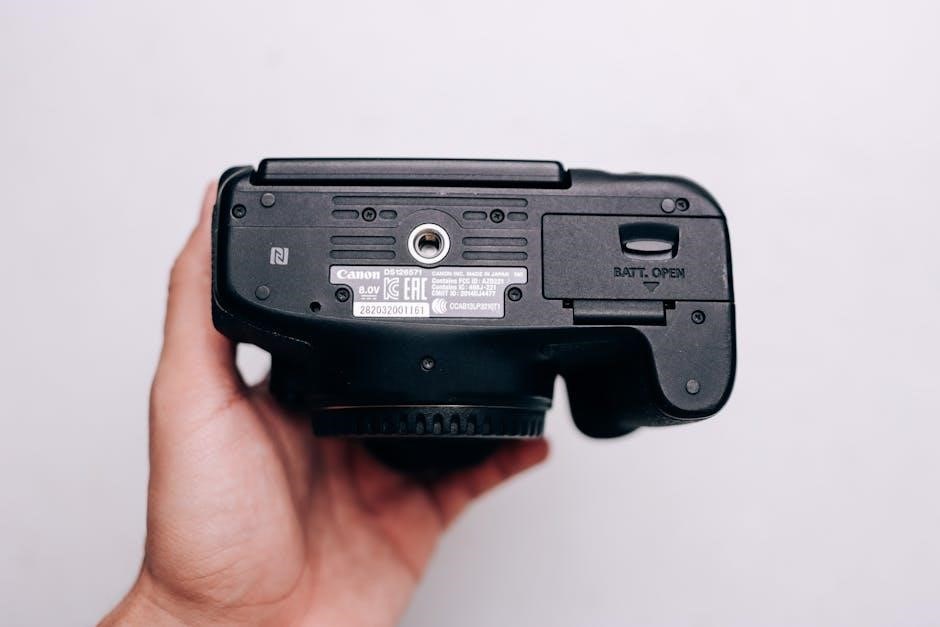
To insert the battery into your Canon Rebel XS, locate the battery compartment, usually on the bottom of the camera. Unlock the compartment latch and gently slide the battery into place, ensuring it clicks securely. Proper alignment is essential to avoid damage.
Removing the battery is equally straightforward. Press the release button within the battery compartment – do not force it. The battery will partially eject, allowing you to easily remove it. Always handle the battery with clean, dry hands.
Avoid touching the battery terminals and store the battery in a cool, dry place when not in use.
Attaching and Removing a Lens
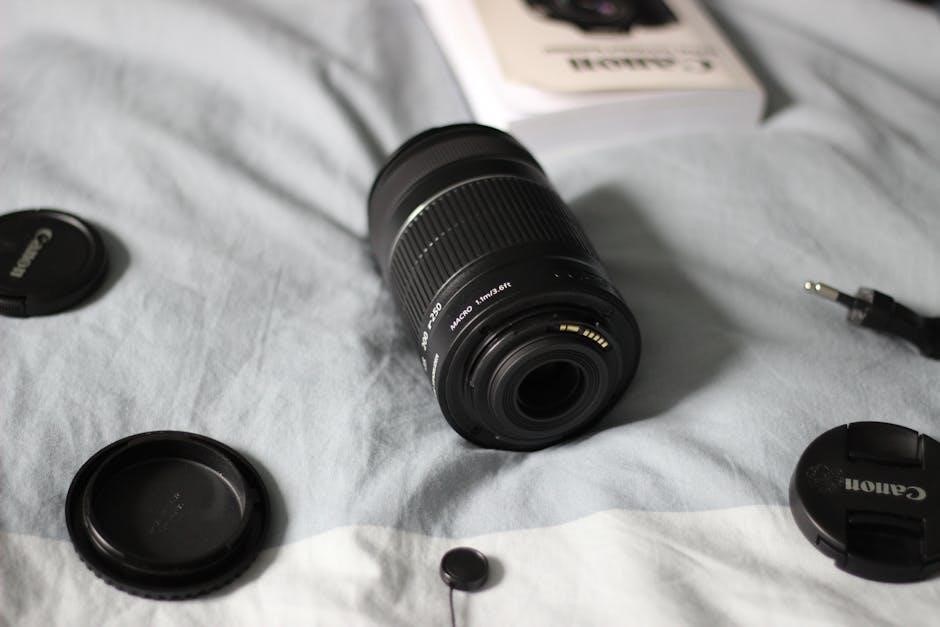
Attaching a lens begins by aligning the red dot on the lens with the corresponding dot on the camera body. Gently insert the lens into the mount and rotate it clockwise until it clicks into place. Avoid forcing it; smooth rotation indicates proper seating.
Removing a lens requires pressing the lens release button on the camera body. While holding the button, rotate the lens counterclockwise and carefully pull it away from the camera.
Always point the lens downwards to prevent dust from entering the camera body. Store lenses with a cap on to protect the glass.
Memory Card Basics (SD Cards)
The Canon Rebel XS utilizes Secure Digital (SD) cards for storing photos and videos. Ensure the card is compatible; SDHC cards (up to 32GB) are generally supported. Insert the card with the label facing upwards into the card slot, gently pushing until it clicks.
To remove, press the card inward to release it, then pull it out. Always format the card in the camera before first use, and periodically thereafter, to optimize performance. Avoid removing or turning off the camera during card access.
Capacity dictates how many images you can store.

Basic Camera Operations
Mastering fundamental controls is key to using the Canon Rebel XS. This section details powering the camera, selecting shooting modes, and utilizing focus and shutter functions.
Powering On and Off
To power on your Canon Rebel XS (EOS 1000D), locate the power switch around the shutter button. This switch has three positions: Video, Photo, and Off. Moving the switch to Photo will activate the camera, and the LCD screen will illuminate, displaying the live view or shooting information.
Turning the camera off is equally straightforward. Simply slide the power switch back to the Off position. The LCD screen will darken, and the camera will enter a standby mode, conserving battery life. Ensure the camera is fully powered off when not in use to prevent accidental battery drain or potential issues. Remember to remove the battery for extended storage.
Setting the Shooting Mode
The Canon Rebel XS offers various shooting modes accessible via the mode dial located on the top right of the camera body. These modes cater to different skill levels and shooting scenarios. Auto mode simplifies operation for beginners, while Program (P) allows some control over settings.
Shutter Priority (Tv) lets you set the shutter speed, ideal for action shots, and Aperture Priority (Av) controls depth of field. Manual (M) provides full creative control. The dial also includes scene modes like Portrait, Landscape, and Sports, optimizing settings for specific subjects. Selecting the appropriate mode is crucial for achieving desired results.
Understanding the Focus Modes
The Canon Rebel XS provides several focus modes to suit different shooting situations. One-Shot AF is best for stationary subjects, locking focus when the shutter button is half-pressed. AI Servo AF continuously tracks moving subjects, maintaining focus as they move – perfect for sports or wildlife.
AI Focus AF intelligently switches between One-Shot and AI Servo, attempting to determine the subject’s movement. Manual Focus (MF) allows precise control, useful in low light or for specific creative effects. Selecting the correct focus mode ensures sharp, clear images, and understanding these options is key to successful photography.
Using the Shutter Button
The shutter button on your Canon Rebel XS controls when the camera captures the image. Pressing it halfway activates the autofocus system, confirming focus with a beep and indicator light. Holding it halfway allows recomposing the shot while maintaining focus.
A full press of the shutter button takes the picture. Avoid jarring movements during this process to prevent blur. Utilizing the self-timer function, accessed via the menu, can eliminate camera shake for static scenes. Understanding the two-stage press is crucial for sharp, well-timed photographs.

Shooting Modes Explained
The Canon Rebel XS provides various shooting modes, from fully automatic for simplicity to manual control for experienced photographers, offering creative flexibility.
Auto Mode (Full Auto)
Auto Mode on the Canon Rebel XS is designed for absolute beginners, simplifying photography by letting the camera handle all settings. It automatically determines the optimal exposure, focus, and white balance, ensuring well-lit and properly colored images with minimal user input. This mode is ideal for everyday snapshots and situations where quick, hassle-free shooting is prioritized.
The camera intelligently selects the appropriate scene mode based on the subject, such as portrait, landscape, or macro, further optimizing image quality. While offering convenience, Auto Mode limits creative control, as users cannot adjust settings like aperture or shutter speed. However, it’s a fantastic starting point for learning the basics and capturing memorable moments effortlessly.
Program Mode (P)
Program Mode (P) on the Canon Rebel XS offers a balance between automatic operation and creative control; The camera automatically sets the aperture and shutter speed for proper exposure, but allows the photographer to adjust other settings like ISO, white balance, and picture style. This mode is excellent for situations where you want some control over the final image without the complexity of fully manual settings.
Program Mode provides a stepping stone from full Auto, enabling experimentation with different settings to achieve desired effects. It’s a versatile option for various shooting scenarios, offering a good compromise between convenience and customization, allowing for a more personalized photographic experience.
Shutter Priority Mode (Tv)
Shutter Priority Mode (Tv) on the Canon Rebel XS empowers you to control the shutter speed while the camera automatically adjusts the aperture for correct exposure. This is ideal for capturing motion – freeze action with fast shutter speeds or create motion blur with slower ones. Understanding this mode is crucial for sports, wildlife, or any dynamic subject matter.
The Tv mode allows creative control over how movement is rendered in your images. Experimenting with different shutter speeds will dramatically alter the look and feel of your photographs, offering artistic possibilities beyond automatic settings. It’s a powerful tool for photographers seeking specific effects.
Aperture Priority Mode (Av)
Aperture Priority Mode (Av) on the Canon Rebel XS lets you select the aperture (f-stop), controlling the depth of field, while the camera automatically sets the shutter speed for proper exposure. A wider aperture (lower f-number) creates a shallow depth of field, blurring the background – perfect for portraits. Conversely, a narrower aperture (higher f-number) increases depth of field, keeping more of the scene in focus, suitable for landscapes.
Mastering Av mode allows for artistic control over focus and background aesthetics. Experimenting with different apertures will significantly impact the visual storytelling of your images, offering creative flexibility beyond fully automatic modes.
Manual Mode (M)
Manual Mode (M) grants complete control over both aperture and shutter speed on your Canon Rebel XS, demanding a thorough understanding of exposure principles. This mode is ideal for challenging lighting situations where automatic modes struggle, or when a specific creative effect is desired. You independently adjust each setting, monitoring the light meter to achieve proper exposure.
While initially complex, mastering Manual mode unlocks full photographic potential. It fosters a deeper connection with the camera and allows for consistent results, regardless of the scene’s conditions, offering ultimate artistic freedom.

Understanding the Menu System
The Canon Rebel XS menu allows customization of camera settings, offering options for image quality, autofocus, and various functions for personalized control.
Navigating the Menus
The Canon Rebel XS utilizes a straightforward menu system accessed via the ‘MENU’ button on the camera’s rear panel. The menu is divided into several tabs, each representing a different category of settings – shooting, AF, quality, setup, and more.
Use the directional buttons on the back of the camera to scroll through these tabs and select desired options. The LCD screen displays the available choices, and pressing the ‘SET’ button confirms your selection.
Understanding the menu’s logical organization is key to efficiently customizing your camera. Don’t hesitate to explore each tab to familiarize yourself with the extensive range of settings available, allowing you to tailor the camera to your specific shooting needs and preferences.
Customizing Menu Settings
The Canon Rebel XS allows extensive customization through its menu system, enabling photographers to personalize the camera’s operation. Within each menu tab, numerous settings can be adjusted to suit individual preferences and shooting styles.
You can modify image quality, white balance, AF operation, and various camera functions. Explore options like customizing the button functions, display settings, and even the menu language.
Remember to save your preferred settings to avoid repeatedly reconfiguring the camera. Experimenting with these customizations unlocks the full potential of the Rebel XS, allowing you to optimize it for your unique photographic vision.
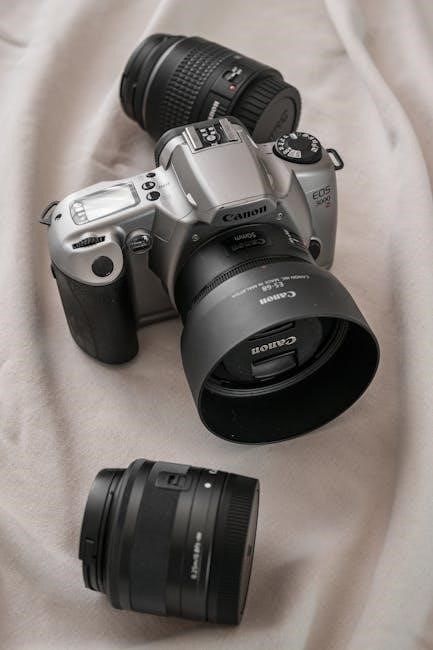
Image Quality and Settings
The Canon Rebel XS manual details adjusting image size, quality, and white balance for optimal results, alongside crucial ISO settings for varying light conditions.
Image Size and Quality
The Canon Rebel XS user manual thoroughly explains how to configure image size and quality settings to balance file size and detail. Users can select from Large, Medium, and Small image sizes, impacting the resolution of captured photographs.
Quality settings, denoted as Fine or Normal, determine the level of JPEG compression applied. Fine offers superior image quality with larger file sizes, ideal for printing or extensive editing. Normal provides a good balance between quality and storage space.
The manual also clarifies RAW image capture, offering maximum editing flexibility but requiring post-processing. Understanding these options allows photographers to tailor settings to their specific needs and intended use of the images.
White Balance Settings
The Canon Rebel XS user manual details the importance of white balance for accurate color reproduction. It explains how different light sources emit varying color temperatures, impacting image hues. The camera offers several preset white balance modes, including Auto, Daylight, Cloudy, Tungsten, and Fluorescent, simplifying adjustments for common scenarios.
Users can also utilize Custom white balance, allowing precise calibration using a white or gray card. This ensures colors appear natural and true-to-life. The manual clarifies how to adjust white balance in post-processing, offering flexibility for fine-tuning images.
Understanding and mastering white balance is crucial for achieving visually appealing and accurate photographs.
ISO Settings
The Canon Rebel XS user manual thoroughly explains ISO settings and their impact on image brightness and noise. ISO determines the camera sensor’s sensitivity to light; higher ISO values are useful in low-light conditions but introduce more digital noise. The manual details the Rebel XS’s ISO range, typically from 100 to 1600, with a boost option to 3200.
It advises users to keep ISO as low as possible to maintain image quality. The manual also discusses Auto ISO, which automatically adjusts sensitivity based on lighting. Understanding the trade-off between brightness and noise is key to optimal image capture.
Playback and Reviewing Images
The Canon Rebel XS manual guides users through viewing photos on the LCD screen, deleting unwanted images, and protecting important pictures from accidental erasure.
Viewing Images on the LCD Screen
The Canon Rebel XS user manual details how to effectively utilize the camera’s LCD screen for image playback. After capturing photos, pressing the playback button allows for immediate review. Users can navigate through images using the directional buttons, zooming in to inspect details with the zoom control.
The manual explains single-image view and multi-image index display options. Information displayed includes shooting settings, histogram, and overexposure warnings. Rotating the Quick Control dial adjusts brightness during review. The manual also covers utilizing the INFO button to toggle displayed information, offering a customizable viewing experience tailored to individual preferences for efficient image assessment.
Deleting Images
The Canon Rebel XS user manual provides clear instructions on deleting unwanted images. Access the playback mode, then select the image(s) for removal. Pressing the delete button initiates the process, prompting a confirmation message to prevent accidental erasure. Users can choose to delete a single image or multiple selections at once.
The manual details options for protecting images from accidental deletion via the protect function. It also explains how to format the memory card, which permanently erases all data; Be cautious when formatting, as this action is irreversible. Following the manual’s guidance ensures safe and efficient image management.
Protecting Images
The Canon Rebel XS user manual explains how to safeguard your precious photos from accidental deletion. Within playback mode, selecting the protect function prevents images from being erased during card formatting or individual deletion processes. This feature is crucial for preserving important memories.
The manual details accessing the protection settings through the menu system. Protected images display a key icon on the LCD screen, visually confirming their safeguarded status. Remember to unprotect images when you intend to delete them. Utilizing this function, as described in the manual, offers peace of mind and prevents data loss.
Advanced Features
The Canon Rebel XS manual details features like Live View shooting, built-in flash options, and customizable Picture Styles for creative control over images.
Live View Shooting
The Canon Rebel XS user manual explains Live View as a feature allowing you to compose and review images on the camera’s LCD screen, rather than through the optical viewfinder. This is particularly useful for precise focusing, especially in challenging lighting conditions or when using a tripod.
The manual details how to activate Live View, along with its limitations, such as potential for sensor overheating during prolonged use. It also covers the different focus modes available within Live View, including FlexiZone-Single and Live Face Detection, enhancing accuracy. Understanding these settings, as outlined in the manual, unlocks greater control and creative possibilities when shooting.
Using the Built-in Flash
The Canon Rebel XS user manual thoroughly explains the functionality of its integrated flash. It details how to activate and deactivate the flash, alongside various flash modes like Auto, Manual, and Red-Eye Reduction. The manual clarifies when to utilize flash – for low-light situations or to fill shadows – and cautions against overuse, which can result in harsh lighting.
Furthermore, it guides users on adjusting flash exposure compensation for fine-tuning brightness. The manual also covers utilizing the flash with external flash units, expanding creative options. Mastering these settings, as described, allows photographers to effectively control illumination and achieve desired image results.
Understanding Picture Styles
The Canon Rebel XS user manual dedicates a section to Picture Styles, pre-set image processing options influencing color, contrast, and sharpness. These styles – Standard, Portrait, Landscape, Neutral, Faithful, and Monochrome – offer creative control without complex post-processing. The manual explains how each style alters the image’s appearance, catering to different shooting scenarios.
Users can customize these styles, adjusting sharpness, contrast, color saturation, and tone to match their preferences. The manual details how to register custom styles for consistent results. Understanding Picture Styles empowers photographers to achieve desired aesthetics directly within the camera, streamlining their workflow.
Troubleshooting Common Issues
The Canon Rebel XS manual provides solutions for typical problems like power failures, lens errors, and memory card issues, ensuring smooth operation.
Camera Not Turning On
If your Canon Rebel XS fails to power on, the user manual suggests several checks. First, ensure the battery is correctly inserted and fully charged – a common oversight. Verify the battery contacts within the camera and the charger are clean and free of obstruction.
Next, try a different, known-good battery if available, to rule out a faulty power source. Also, confirm the power mode dial isn’t set to ‘OFF’ or a setting that disables power. Inspect the battery compartment for any damage. If the issue persists, consult the manual’s troubleshooting section for further diagnostic steps or contact Canon support.
Lens Errors
Encountering lens errors on your Canon Rebel XS, as detailed in the user manual, often indicates a communication issue between the camera body and the lens. First, ensure the lens is securely mounted – remounting can resolve connection problems. Inspect both the lens contacts and the camera body’s lens mount for dirt, dust, or damage; carefully clean them with a soft cloth.
Try a different compatible lens to determine if the problem lies with the lens itself or the camera body. The manual advises checking for firmware updates for both the camera and lens, as these can address compatibility issues. If errors persist, professional repair may be necessary.
Memory Card Errors
The Canon Rebel XS user manual addresses memory card errors, a common issue. These often manifest as “Card is not formatted” or “Card error occurred.” First, ensure the card is compatible (SD cards are required) and properly inserted. Attempt to format the card within the camera – this often resolves minor errors.
If formatting fails, try a different SD card to isolate the problem. Use a computer to check the card for errors and, if necessary, reformat it using the card reader’s software. Avoid removing the card during data transfer. Corrupted cards may require replacement, as detailed in the manual’s troubleshooting section.
Maintenance and Care
The Canon Rebel XS manual stresses regular cleaning of the body and lens with appropriate tools to ensure optimal performance and longevity of your camera.
Cleaning the Camera Body
According to the Canon Rebel XS manual, keeping the camera body clean is crucial for its longevity and proper function. Begin by turning off the camera and removing the battery before any cleaning procedures. Use a soft, dry, lint-free cloth to gently wipe away dust and fingerprints from the exterior surfaces.
For stubborn smudges, slightly dampen the cloth with a minimal amount of water – avoid getting moisture into any openings. Never use strong solvents, alcohol, or abrasive cleaners, as these can damage the finish; Pay particular attention to the LCD screen, using a dedicated lens cleaning cloth for optimal results. Regularly blowing away dust from crevices with a blower can also prevent buildup and maintain a pristine appearance.
Cleaning the Lens
The Canon Rebel XS manual emphasizes careful lens cleaning to maintain image quality. Always start by using a blower to remove loose dust and debris from the lens surface. If smudges remain, use a soft, lint-free lens cleaning cloth. Apply a few drops of lens cleaning fluid to the cloth, not directly onto the lens.
Gently wipe the lens in a circular motion, starting from the center and moving outwards. Avoid excessive pressure. For stubborn marks, repeat the process with a clean section of the cloth. Never use household cleaners or abrasive materials, as they can scratch the lens coating. Store lenses with caps on to prevent dust accumulation.